
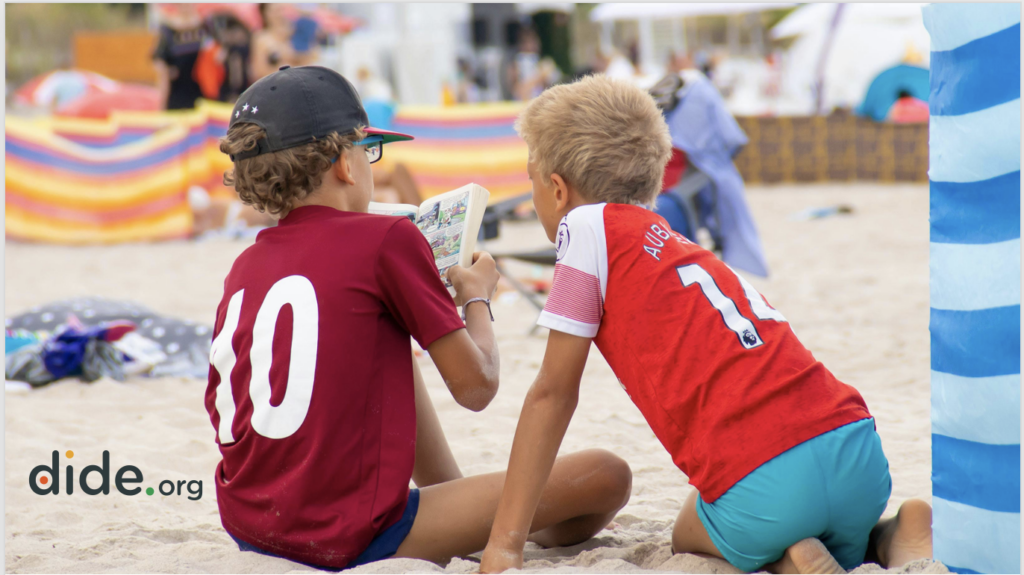
Summer is here, and with it, the long-awaited school vacations. A period of rest and disconnection for the little ones, but which can also be an opportunity to reinforce learning and acquire new knowledge in a fun way. Multiple studies have demonstrated the benefits for children who maintain certain learning routines during the vacation period:
1.- Effects of summer learning on students’ academic performance: A meta-analysis. Authors: Cooper, H., Nye, C., Hedges, L. V., & Borman, G. D.
This meta-analysis examined the effects of 85 studies on the effectiveness of summer learning programs on students’ academic performance. The results found that summer learning programs have a positive and significant effect on students’ academic performance, especially in the areas of reading and mathematics.
Highlights:
- The positive effect of summer learning is greater for students from disadvantaged socioeconomic backgrounds.
- Summer learning programs that are longer, more intensive, and of higher quality have a greater impact on student performance.
- Programs that focus on reading and mathematics are more effective than those that focus on other subjects.
2.- The impact of reading during the summer on children’s vocabulary and reading comprehension. Authors: Kim, D. H., & Hirsh-Pasek, K.
This study investigated the impact of reading during the summer on the vocabulary and reading comprehension of 50 first-grade children. The children were randomly assigned to one of two groups: a reading group and a control group. The reading group received books and reading materials to take home and read during the summer vacation. The control group did not receive reading materials.
Highlights:
- The children in the reading group showed a significant improvement in their vocabulary and reading comprehension at the end of the summer, compared to the children in the control group.
- The positive effects of reading during the summer were maintained until the following fall.
- The study suggests that reading during the summer can be an effective way to help children avoid the learning loss that usually occurs during vacations.
These are just two of the many examples that show that it is advisable to find an appropriate balance between leisure and review of concepts during the summer period, so that your children can make the most of their vacations while consolidating their learning and preparing for the next school year. Here are the main recommendations that our experts have prepared.
1. Planning and organization: the key to success
Establish a flexible schedule that includes both free time and review activities. Adapt the schedule to the needs and learning rhythms of each child, without overloading them.
2. Play as a learning tool
Play is an essential activity in children’s development. Take advantage of the holidays to encourage educational games, board games, puzzles, or outdoor activities that stimulate their critical thinking, creativity, and problem-solving.
3. Reading: a pleasure for life
Instilling the habit of reading from an early age is an invaluable gift. Dedicate some time each day to reading stories, comics, or books adapted to your children’s age.
4. Review without stress: make it fun!
Reviewing basic concepts in a playful and attractive way is possible. Use online educational games, mobile applications, or create your own review materials. Remember that the key is for learning to be meaningful and motivating.
5. Reinforcing mathematics: playing with numbers!
There are many games and everyday activities that allow you to review mathematics in a fun way. Take advantage of mealtime to calculate quantities, play board games with numbers, or perform estimation and counting activities.
6. Learning languages: a trip without leaving home!
Watching movies and series in the original version with subtitles in Spanish, listening to music in other languages, or reading simple children’s stories are some ideas for children to learn languages naturally and fun during the holidays.
7. Don’t let them forget the routines!
It is important to maintain some basic routines during the holidays, such as sleep, hygiene, and meal schedules. This will help children adapt better to going back to school and will prevent sleep and eating disorders.
8. Take advantage of family time
Vacations are an excellent opportunity to spend quality time with family. Do activities together, such as excursions, outdoor games, or visits to museums.
It is important that you help and support your children in the search for that balance that allows them to make the most of the holidays and reinforce their learning in a fun and effective way. We encourage you to listen to our Doctor of Psychology, Nuria Ros, on La Tarde con Marina to expand the information on this topic. At Dide.org we are experts in detecting educational, emotional, and behavioral potentials and difficulties early in order to intervene. You can access the diagnostic tool in this link.
