
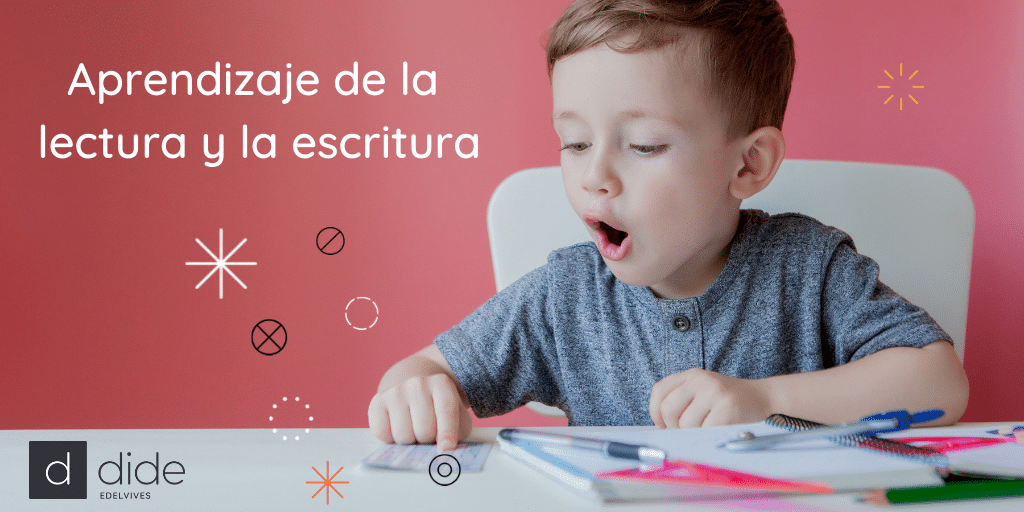
One of the most important milestones in childhood is the acquisition of reading and writing. An appropriate teaching-learning process is essential for this. However, some children have problems in these areas.
Before stating that a child shows alterations in literacy, it is necessary to rule out alterations in vision or hearing, physical problems that may interfere with reading, absence of emotional or neurological disorders, and a normal IQ that allows them to develop these capacities.
There are different reasons why a child may have literacy alterations, such as an inadequate teaching method or unfavorable environmental factors, among others. We will also assess other important aspects such as difficulty in copying, modifications in laterality, perception, psychomotricity, attention, calculation, memory, following complex orders…
Writing and reading are distinct processes, but two sides of the same coin. They use the same code to decipher; however, the purposes for which one writes are different from those for which one reads. When producing writing, the subject uses the same signs, but the intentionality guides them to search for possible combinations in order to construct exactly what they want to express.
It may happen that the child suffers a delay in the development of reading acquisition and, therefore, in writing. This delay is usually more evident at the age when children start learning to read, between 6 and 8 years of age, although it can start to be detected from 4-5.
Signs to identify difficulties in reading and writing
Regarding the area of writing:
- Alteration of the order of letters in a total or partial way
- Problems in the orientation of the strokes of certain letters
- Confusion of similar letters, such as /p/-/b/ p /d/-/b/
- Clumsiness and lack of manual coordination
- Inadequate posture of both the child and the paper when writing
- Excessive tension or lack thereof when writing
- Multiple errors when writing (omissions, substitutions, inversions, or additions)
Regarding the area of reading:
- Deterioration in reading
- Significantly lower performance than expected in relation to their personal and school characteristics.
- Difficulty distinguishing some letters or reading them in the correct order.
- Omit letters or words.
- Slow reading, with syllabification, loss of line… has difficulty reading words and phrases.
- Lack of reading comprehension.
The phases of learning to read
The logographic, in which the child identifies logos, images with words. Knows brands and symbols by their drawing.
The alphabetic, in which they begin to relate letters to their sound. They become familiar with the alphabet and can read phonemes and even syllables.
The orthographic in which already recognizes groups of letters and words. Begins to read.
And to conclude the fluent-expressive, in which the child reads perfectly respecting punctuation, representing the reading and understanding what they read. It is feasible that difficulties arise in the progress of these stages.
Main disorders in learning to read
They are deficient or dyslexic reading, and perhaps the most publicized of learning difficulties. Literally, dyslexia means “poor quality in the word.” Without going into depth, dyslexia can be phonological, superficial, or profound. Letters, syllables, or words are confused or omitted. The order of these is altered, or they are mistaken in the sound of similar letters.
Bradylexic reading consists of the child reading without errors but very slowly.
The antithesis of the previous one or tachylexic reading, that is, the child reads too fast.
Dysrhythmic reading consists of not respecting pauses or order, as well as punctuation marks. Reads quickly at times and slowly at others.
Mnesic reading is when the child learns the text by heart from hearing it and pretends to read, but when they are told something specific to read, they do not know.
The imaginary reading is done by the child, based on the drawings and inventing the story without it authentically coinciding with the words.
The dragged reading emerges due to difficulties in global perception that prevent correctly obtaining the whole of the reading and generates a delay in reading to be able to assimilate the entire text.
In repeated reading, the child reiterates the first syllables of the words. In silent repeated reading, the child repeats the syllables but to themselves, in a low voice.
Mixed reading combines silent and dragged reading.
Other problems that may present difficulties in literacy is attention deficit hyperactivity disorder (ADHD). Do not confuse dyslexia with ADHD. Children with reading difficulties may be restless, and this can be confusing.
It is also necessary to consider a disorder in this case auditory such as auditory processing disorder or APD, which affects the ability of children to process the information they hear. It can make it difficult for children to understand what people are saying or make it difficult for them to follow the story of a story aloud. Let us clarify that reading requires the ability to connect sounds with letters.
These disorders are detected with an examination that will assess their reading ability, always taking into account the age of the child and the training. It is carried out by reading letters, syllables, texts with and without drawings, in print and handwritten. Based on the results, it is established whether the child has any problem reading that should be corrected.
Teaching to read and write, as well as teaching to think, is educating for the hope of a better quality of life
Reading is a process of constructing the meaning of a text in which data from the text is coordinated with data from the context. The reader’s role activates their linguistic and cognitive skills in order to participate in this process of transaction with the text. The strategies for successful reading are sampling, anticipation, prediction, self-correction, and inference.
Let’s start from the fact that learning to read is a difficult and decisive task that forms the basis of later learning. A child does not learn to read and write to do homework or to pass the school year; let’s consider that the reality of a child is not that they care about the future, the child needs to learn things that are useful to them today and not tomorrow.
A correct educational process should always worry about the present, trying not to ruin what has been done in the past and using it in each and every one of its potentialities. Dr. Tonucci
There are numerous children who learn to read and write with moderate effectiveness; the disadvantage is that they have learned to consider reading and writing as boring and exhausting activities that must be done obligatorily. Children can read and write, but they do not choose to do so freely.
It would be ideal to carry out learning as a constructive and dynamic process and not as a sequence of meaningless steps that quickly become unpleasant activities for children.
Reading is important to develop attention and concentration, develop the ability to decode and understand messages, help decentralization and empathy, have a dialogical attitude to listen and learn from others, get in touch with our introspection, it is an indispensable way to get in touch with the world, with knowledge, other realities, with the past, diverse opinions… A large part of information comes to us in writing. Knowledge broadens our perspective and the development of criteria to understand and interpret our own reality. Staying up to date, in this era in which scientific and technological advances are advancing rapidly, whoever does not read becomes outdated.
Techniques for early detection of literacy difficulties
The best intervention and help to their needs that can be provided to a minor with literacy difficulties is early detection.
dide offers in a simple way, through the observation of the child by adults (at least two of the main areas of the child, family-educational), the possibility of identifying up to 35 indicators, starting from the age of two years.
Focusing on literacy, through the combined questionnaire dide with 29 indicators for the age of 4-5, and the equivalent for 5-6, an accurate screening can be achieved to detect possible difficulties as well as discriminate false positives.
You may be interested in:
Orienting assessment for the early detection of learning and development difficulties in students.
How to identify my child’s learning difficulties and needs?
How to implement the dide tool in my educational center? REQUEST AN ONLINE INTERVIEW


If you are a teacher, educational counselor, or education student and want to learn how to manage an inclusive classroom, this Online Course (e-learning) is for you. With resources, weekly tutorials, +100 recognized hours, 8 experts. Start today and set your own pace. Get certified.