
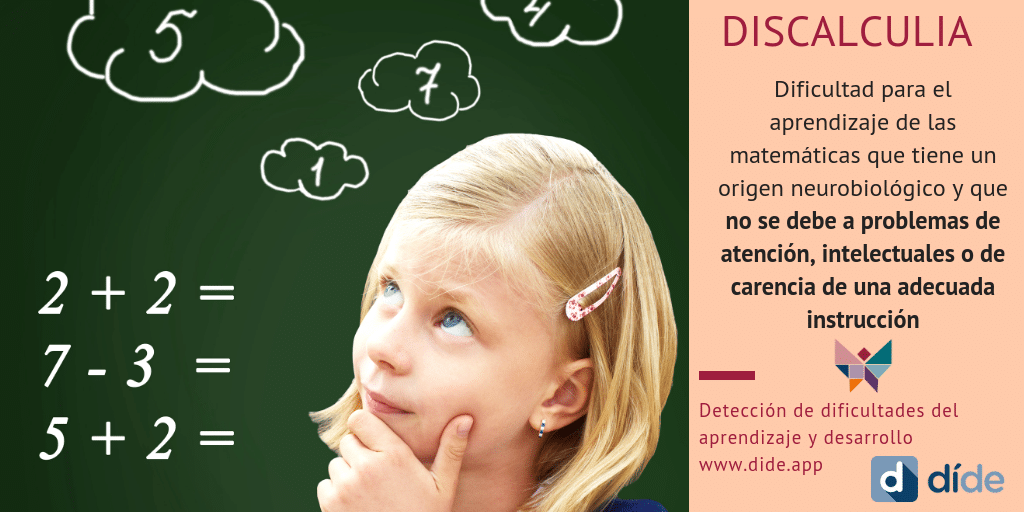
Dyscalculia is included within specific learning disorders. In the early childhood education stage, the first signs can begin to be identified, long before it starts to cause problems.
What is dyscalculia?
It is the disorder that affects the learning of basic arithmetic knowledge: addition, subtraction, multiplication, and division, which poses a problem when understanding and performing mathematical calculations. “Dyscalculia is a difficulty in learning mathematics that has a neurobiological origin and is not due to attention, intellectual, or school deprivation problems,” says Javier García Orza, from the Numerical Cognition Laboratory, at the University of Malaga.
The study of this learning difficulty began at the end of the 19th century and has acquired different names: Gertsman Syndrome, Acalculia, or Arithmetic Development Disorder.
There are 4 types of dyscalculia, we are going to describe their main characteristics:
- Primary dyscalculia: difficulty related to a neurological injury.
- Secondary dyscalculia: associated with a low reasoning ability and space-time orientation. It is characterized by poor use of numerical symbols.
- Disametrica: difficulty in solving operations and problems.
- Spatial dyscalculia: They have difficulty ordering and structuring numbers.
As we see in the 4 main types of dyscalculia, different types of aptitudes or skills related to these factors can be affected, and they are very important for the learning and development of boys and girls.
There are children who have difficulties with mathematics but not because they have dyscalculia.
The incidence of dyscalculia is estimated to be between 4% and 8% of the population. These data suggest that a teacher who has 25 students is very likely to have a student in class with dyscalculia.
In general, difficulties with calculation and writing begin to become more visible in primary education, where most detections and diagnoses are usually made.
But there are symptoms that make detection and prevention possible a little earlier, which is why for this and other difficulties, the platform díde begins to pre-evaluate them between 4 and 5 years of age, through digital questionnaires answered by parents and teachers, who know them best, you just have to activate their observation to obtain the necessary information. Dide takes care of it. The sooner we can detect and prevent, the less the consequences will be as well as the necessary adaptations in their learning, since as you know, the knowledge and skills acquired in the first years of life are key.
The symptoms vary depending on age:
In the childhood stage, we can already realize that “the numerical world is relatively foreign to them”, explains the expert. They understand small quantities, at most three or four, they have difficulty counting, deciding where there are more elements, understanding concepts related to mathematics, such as “bigger than” “the smallest”.
The difficulties continue in primary school and also in secondary school, they continue to use their fingers to solve operations, they easily forget mathematical concepts and procedures, they have difficulty learning multiplication tables, they make mistakes with money and hours, although they master some procedures they do not understand the logic that underlies them.
“At the academic level, the child fails in mathematics and runs away from subjects related to this area.” Frustration appears due to the demands of the stage, associates his inability to being clumsy, suffers, becomes demotivated, his self-esteem weakens and abandons other subjects, even if they have nothing to do with mathematics.
There is a clear parallel between dyslexia and dyscalculia, however, their origin and manifestations are different.

When a child has difficulty reading, he is labeled dyslexic, he is excused and offered intervention programs and curricular adaptations, the same does not happen in the case of children with difficulties in mathematics, in this case he is labeled clumsy and it is assumed that he does not give more of himself. Javier García Orza
What can we do once a difficulty in learning mathematics is identified?
There are many ways to help a child with difficulty learning mathematics even before the final diagnosis, dyscalculia, since it may take longer than expected to be carried out due to referrals to competent professionals, the transfer of information between them, etc. Support, understanding and letting them know that they are not alone in the face of their difficulties is vital for their development and self-esteem.
From díde we encourage you to raise awareness in the environment, both in schools, institutes and teachers as well as in families. It is possible to detect early in a simple way and prevent later problems! In addition, this prevention is accompanied by orientation guidelines adapted for people who live with the child.
In general, the strategies and orientation guidelines to address dyscalculia are divided into four main categories:
- Facilitate alternatives, adapting the way of reaching knowledge or adapting the way of evaluating it.
- Small modifications in the activities to prevent the area of difficulty from being the center of attention of the task.
- Performance: work with specific exercises to improve calculation.
- Recognize and reinforce the many other potentialities and skills of children.
Educating and learning at the same time is one of the most rewarding things that can happen. The range of possibilities offered by education and technology is infinite, let’s open it together!
The impossible could not have happened, therefore the impossible must be possible despite appearances.
This quote is from Agatha Christie (1890–1976), historians think that she may have had reading and writing difficulties. They do not know if dysgraphia, dyslexia or both. Her novels continue to be among the most well-known books worldwide.
Early detection of learning and development difficulties