
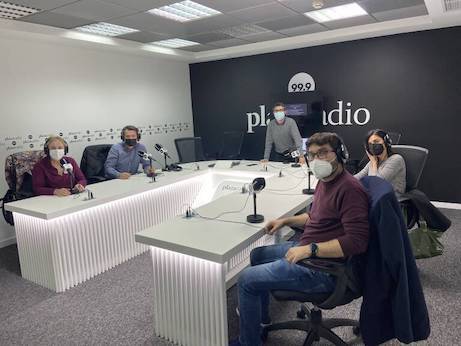
This week we participated in the program “La tarde con Marina” on Radio Plaza, in an educational discussion on attention to diversity and inclusion. One of the most important conclusions we agreed on is the need to know the student. How can we address diversity if we do not know their needs?
Paola de la Cruz: Educational activist and defender of the first cycle of early childhood education. Best teacher in Spain 2020 Educa Abanca awards. Pedagogical director of Dino School Children’s Centers.
Francesc Nogales: Innovative primary school teacher, writer, Best teacher in Spain 2021 Educa Abanca awards, co-author of the online course “Management of attention to diversity in the classroom”.
Alberto Ramírez: Specialist in educational technology, author of DIDE, a platform for observing and understanding the educational needs of children.
Nuria Ros: Doctor in Psychology, forensic judicial expert, specialist in learning difficulties.
With all of them, we discussed education, diversity, and inclusion. We summarize below the most important points that were discussed.
What is diversity?
We started the discussion by defining what diversity is: “richness, abundance, it is what each of us is and what we really have to address. To be diverse is to be oneself. When we focus on diversity as something negative or lacking, we are losing sight of the richness,” -explains Nuria Ros-.
Let’s think about a family, what happens when there are two children, one of whom has problems?
Indeed, we tend to focus on that child with problems because we naturally consider that we have to help them, however, we leave the other one aside thinking that they can walk and grow alone. We must take into account that the one who can walk alone is diverse and has needs to cover and also potentialities that must be encouraged -explains Nuria-.
This situation is often repeated in many families, although they should not feel guilty about it, they should simply ask for help.
Following on from what Nuria said, Francesc Nogales recounts the experiences of his childhood when this same situation occurred with his brother with special needs: “My brother focused the attention of my parents while I walked alone.” His vocation for teaching appeared when one day, before taking the Selective exam, he visited his brother’s special education school and saw “how the teachers got stained with paint and played soccer with them. Then I knew that I wanted to be one of those teachers.” Thus, he studied therapeutic pedagogy.
Francesc, a teacher at the San Enrique de Quart school, co-author of the online course “Management of attention to diversity in the classroom” is a firm defender of involving parents in the education of their children, encourages families to ask teachers for help, today there are resources and tools that make it easier for teachers to better understand the child and know what may be hindering their learning and development process.
Teacher, do not lose sight of your objective, your mission is to know each of your students
We move with Nuria to ancient Greece, let’s start from a classical approach, perhaps a somewhat idealistic one, and show the teachers as “paidagogos”, those who exercise the art of teaching children, those who “influence” the mood of the students so that they proceed in a certain way, those who stimulate them to awaken their interest, those who guide.
The metaphor is widespread that the paidagogos through their teaching sow the seed of wisdom in the pais (children), but if we asked a farmer how a robust, healthy, and fertile plant could grow, among many other clarifications he would tell us to start with what type of seed, in what soil and what characteristics it presented, in what season and when…
In short, an immense need to have information and to know, because if it is not known, the result of their harvest would be haphazard and random. In the same way, one must be exhaustive and extensive in terms of the knowledge of our minors, of their needs, of their strengths, of how to really address their diversity, seeking an inclusive education.
The three essential questions I AM, WHO I GO WITH, and WHERE I AM GOING
Nuria Ros invites us to reflect on the importance of knowing the child to meet their needs: “Despite the studies, the research, the theses we have on diversity, inclusion, education, when is the time to start at the beginning? Do we know the child? When do we start with the I AM? If we do not have the I AM, that is, the knowledge and information about the child, how can we meet the need and develop their potential?
In that sense, Paola de la Cruz, aware of the importance of Early Childhood Education to lay the foundations for both learning and the emotional and cognitive development of the child, points out that the most important thing is to be aware of what we have to work on and where we have to look, and transferred to respectful parenting, she points out: “we must listen to know, because if you listen and know, you provide what they need”. “Diversity must also value the beauty of the imperfect” -said Paola-.
The discussion also addressed the need for movement in minors, Francesc Nogales considers sport essential for physical and mental well-being “We have to work on sport with children. Sport is moving, running, playing… a problem of hyperactivity or lack of attention improves considerably with physical activity”. Sport teaches minors to know how to lose, companionship, effort, sacrifice, perseverance. Good habits and values necessary for cognitive and emotional development that will always last.
Paola, defender of free movement, which consists of letting the baby move freely without advancing postures or positions, since we understand that the will to move occurs spontaneously and autonomously, stated that children need to move because it is part of their development, however, the educational system forces them to remain seated for hours daily.
And following the Greek simile, Nuria Ros reminds us of the “peripatetics” who focused on movement, teaching took place walking, traveling, guiding.
How can we delve into the I AM of the minor to know what their real needs are?
Specialists begin to detect disorders such as ADHD from the age of 4-5 years, but children with hyperactivity show signs much earlier, “even from the womb” -pointed out Nuria-. Alberto Ramírez, director of the dide educational platform, stressed that dide is positioned at the starting point for the observation and knowledge of the minor, since it facilitates the automatic collection of very valuable information about the child themselves that will help to know their characteristics early to prevent and put into practice some simple guidelines, both for families and for teachers, in the classroom itself.
For Paola, pedagogical director of the Dino School Children’s Schools, the best pedagogical innovation consists of returning to those simple things that allow working on that being, on their emotional needs.
“It is fantastic to have educational tools that allow us from minute zero to know the profiles and who that child is through some markers that will indicate each of the needs, not only special needs, but also high capacities” -declared Paola-
She also claimed that education must ensure the educational success of each and every child, “we cannot spend a whole year without knowing our students (if they are shy, if they are hyperactive, if they have problems at home…), because it is our duty to provide them with everything they need from minute zero”.
The Dino School children’s schools are a reference in stimulation and methodologies such as the Reggio Emilia Philosophy that respects the nature of the child helping them to explore their talent. It is not about teaching systematically and rigorously, but about creating a stimulating environment and guiding them with patience and affection. They are also a reference in the dide methodology that makes it easier for them to observe and deeply know each of the children, this knowledge provides great advantages.
No matter how much we talk about education, there are always things to improve. The new situation we are experiencing with COVID 19 has made us reflect even more on the need to integrate educational technologies into our day to day to advance in the knowledge of the minor and their educational needs also remotely.

