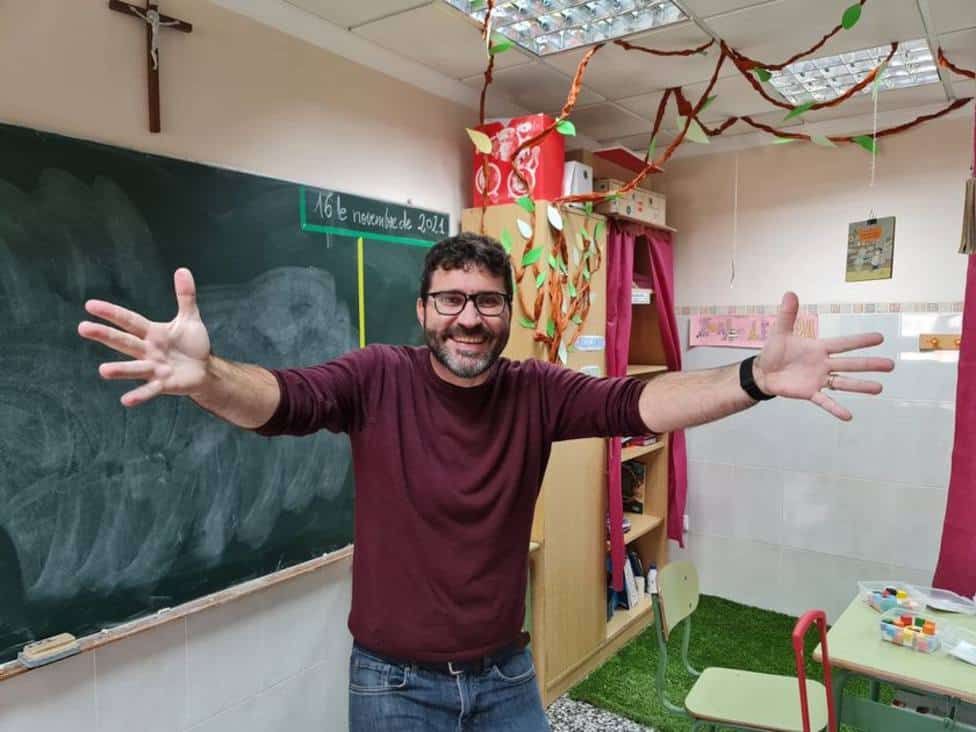
Francesc Nogales Sancho, aka profe Fran, considered the Best Primary School Teacher in Spain (Educa Abanca 2021-2022 awards) as nominated by families and students, receives this recognition after four years of being nominated.
As a teacher trainer, he has participated in the creation of the online course Skills in addressing diversity and educational inclusion in the classroom, is a writer with more than 15 educational titles, and the creator of “three-dimensional education” in which family, teachers, and students share a leading role in the classroom. He considers himself “an ordinary person and a family teacher.”
In our educational discussion on the program “La tarde con Marina” on CVRadio, which we held in 2020, we had the opportunity to speak with this very special guest who made us reflect on the present and future of education. At that time, he was considered the 2nd best teacher in Spain.
Also participating were Nuria Ros Cubel, PhD in psychology, specialist in learning difficulties, and Alberto Ramírez Moreno, author of the dide Methodology for the early detection of educational needs (which recently signed a distribution agreement with the Edelvives publishing house).
We offer you a summary of the program broadcast in 2020:
Francesc, why are you the best teacher in Spain? What must a teacher have, in addition to vocation, to receive this recognition?
The first thing is because I have students who are a treasure and wonderful families. For these awards, the students nominate you. I cannot voluntarily present myself to be the best teacher in Spain, and for the students and families to nominate you for this recognition, I understand that we must be doing something right. I think that the secret is passion and thinking that the student comes before my interests or even my own family, sometimes.
Right now, two profiles of teachers are being defined very clearly: those who promote an education focused on content, in which the syllabi are important, evaluation is based on exams, and students are encouraged to do all their work in a similar way. Other teachers are committed to training the student, not so much to master the content, but to be able to create new things. Teachers who are committed to education through emotions, and who have realized that it is more important to “know how to do” than “just knowing.”

Teachers, students, and families, the class is a group effort
When we think about families and the school, it is because we are going to have a celebration or because they call you for a tutorial (and if they call you, it is because the child has done something wrong; they rarely call you to tell you that your child is doing great), but that is not educational participation, that is informing.
The European Union says that there are certain forms of family participation within the school:
- Informational participation
- Decision-making participation (on the school board, although then by voting they never manage to win because they are fewer).
- Evaluative participation. Did you know that in France there are schools that when they evaluate the student, the family is there? I start from the basis that more than evaluating, what we do is qualify because the student is only in school for 5 hours, and the rest of the time?
- Educational participation. It is the cool participation, that families can enter the classroom, that they can interact, participate, that they gain their protagonism and that the teacher stops being the king, because many times the teachers are that, kings inside the classroom: we command, we say and we do.
The feeling of belonging, of being integrated, is key. Parents get more involved when they feel that their participation is important and see that their child is satisfied and happy, they can show them what they are learning. (Nuria Ros)
My proposal is that teachers be brave and allow families to participate in activities within the classroom, during school hours. More and more teachers are involving parents. Seven years ago, I started a math workshop in which children, teachers, and families worked together, during class time, one day a week. The participation is very good, around 15-16 family members come. Sometimes, they even come without eating because the effort is worth it. If we think about the solutions and not so much about the problems, in the end, we can find ways to involve parents. I don’t know any father or mother who doesn’t worry about their children and who doesn’t want to help them improve.
In the classroom, they learn how to work with their children and motivate them. We work as a team, we pose mathematical challenges, riddles, problems that they solve following some guidelines. I see the children very excited when it is almost time for their parents to arrive.
Tell us about the “Review Your Reading” initiative. What does it consist of?
In the proposal “review your reading” children read what they want, each according to their level, we do not set conditions, then they write a review and every Monday we publish it in the digital newspaper “Valencia Noticias”, and on Thursdays they are broadcast on Radio Manises, on the program “Y mañana viernes”, around 7:00 p.m., the children themselves read them.
We are also working on another initiative that we carry out with third-grade children and in which we involve grandparents. How to explain to children what a municipality is, what services it offers, functions of the town hall, the police, etc.? How can we relate school content to reality so that it is useful and they are motivated?
In this beautiful project, the grandparents explain to us what our municipality, Quart de Poblet, was like years ago. We also explain to them what Alzheimer’s disease is, and that if they learn everything related to the municipality, they will be able to remind their grandparents if necessary in the future. All the children had great motivation and found the usefulness of that learning. With the videos, we created a Documentary that was chosen as the best educational documentary in Spain. This type of work makes them sensitive.
Have you spoken with teachers who have a more conventional way of teaching classes? What do they think of your teaching methods? Do they criticize you or support you?
It’s like everything, some people find it more difficult, but in the end the “educavirus effect” occurs and it works because people gradually get encouraged, all that’s missing is the contagion from school to school. In my school, the situation is very positive, the teachers are doing many things in this regard, I am by no means the one who does the most. Where there’s a will, there’s a way.
We cannot give the same explanations to all children, each one needs something specific, personalized education is very difficult but it is something we should try to achieve, and in that sense, new technologies can help us.
What do you think about the dide method used by your educational center, the San Enrique school?
I think it is something that was needed, in fact, I wonder what has happened in the last 20 years until dide appeared, I don’t understand why no one has had this idea.
With a computer program, families and teachers answer a questionnaire to be able to detect the possible specific difficulties and educational needs that a student has, and it also gives you orientation guidelines. For teachers, it is like a mini magic wand because it makes it easier for them to communicate with parents since they themselves, when answering the questionnaire, realize the difficulties that their child has.
I love the participation of families, I am with my students 5 hours out of 24, I cannot assess whether they deserve one grade or another, nor diagnose their difficulties, we need the family.

Francesc Nogales Sancho, a simple and approachable teacher who is committed to an education in values in which children, families, teachers, and the community work together. His goal? That his students manage to caress their dreams. A teacher always willing to support his students.
Congratulations, profe Fran! Well-deserved recognition.

How do families participate in education within the classroom? WATCH ON YOUTUBE