
The importance of early childhood without violence
Ending violence in the lives of children and investing in early childhood are, above all, issues linked to children’s rights. The healthy physical, intellectual, and socio-emotional development of children depends on the possibility of receiving love and enjoying a welcoming environment from the beginning. For this reason, the participation and involvement of the family nucleus is the basis for stimulating change and improving relationships at home and at school.
Longitudinal studies show that children exposed to violence are more likely to be victims of violence in later stages of life or become aggressors and use violence against their partners or their own children; in addition to running a greater risk of incurring in illicit behaviors.
Violence in early childhood is a stressful and painful experience for a child in the short term, and carries the risk of having consequences in the medium and long term.
(Office of the Special Representative of the Secretary-General on Violence against Children)
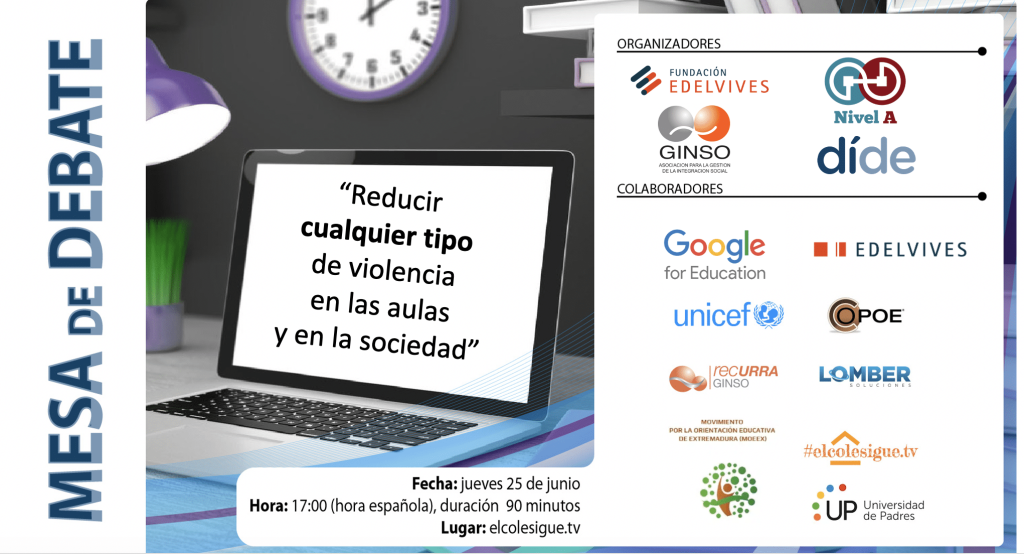
Panel discussion on childhood and violence
Date: June 25
Time: 5:00 PM (Spanish peninsular time)
Location: connection to elcolesigue.tv
Organized by: dide, Fundación Edelvives, Ginso and NivelA
In collaboration with: Google for Education, Edelvives, UNICEF, COPOE, Recurra-Ginso, Lomber, Movement for Educational Guidance of Extremadura, El Cole Sigue.TV and Universidad de Padres.
Panel members:

We will begin with a brief introduction to three initiatives for the prevention of violence in childhood and adolescence and then the debate will be opened with all participants.
Fundacion Edelvives and the project of protection to childhood and adolescence: Do not be silent, tell it
What happens when a child is involved in a deception about which they are asked to remain silent?
In 2018, under the direction of Juan Pedro Castellano, Fundación Edelvives together with Fundación ANAR launched a campaign that responded to a very specific need: to help minors identify a situation of sexual abuse, give them the confidence and courage necessary to report it, offering them clear and simple guidelines on how to act in these cases and providing a range of resources that aim to reach all children and adolescents in Spain and Latin America (such as the story #NoTeCalles by Arturo Cavanna and Menchu Cuesta).
Objectives:
- Offer tools for the knowledge and denunciation of situations of abuse against minors.
- Show the importance of awareness on this issue and the denunciation of abusers.
- Prioritize the commitment to education and childhood.
- Break the circle of silence on the issue of abuse.
- Offer clear and simple guidelines that indicate to children, parents and educators how to act in the face of this type of abuse.
More information: Fundación Edelvives
Ginso presents its proposal for the prevention of violence in schools
The recURRA-GINSO program is a pioneering initiative in Spain endorsed by its director Javier Urra, arises as a response to the lack that exists in the Spanish care field in “the treatment and help to young people in conflict who within the home tyrannize parents, mothers, brothers / sisters or other relatives”.
Objectives
- Respond to a social demand.
- Support and assist families in conflict effectively.
- Restore and strengthen the bond between parents and children in a way that enables an improvement in their relationship.
- Provide parents with the necessary resources to cope with difficult situations in family life.
- Promote in children the values of respect for oneself and others, as well as self-control, empowering them with the necessary tools to manage conflicts in a more appropriate way.
- Provide families with the necessary keys to improve their relational and educational dynamics.
More information GINSO
dide, educational technology for the search of hostile behavioral profiles in minors
What if we could, through prevention, reduce the incidence of bullying, child-to-parent aggression, aggression towards teachers, gender violence, sexual assault, and child abuse?
As is well known, once it is known which children are predisposed to develop these behaviors and there is knowledge of what happens to the minor, the intervention that is required can be done for the greater well-being of the same and its environment.
With the dide methodology (created by specialists in education, psychology and new technologies) we can, through digital questionnaires answered by parents and teachers, look for a pattern in an entire course to early identify children who may present this profile:
- Dominant, demanding and egocentric behavior
- Disobedience
- Difficulty in managing anger
- School maladjustment
- Family maladjustment
- Low tolerance to frustration
- Oppositional defiant behavior
- Anxious mood
- Social maladjustment
- Impulsivity
Related link: dide, aggression and hostile behavior

