
November 25, International Day for the Elimination of Violence against Women
November 25 was declared International Day for the Elimination of Violence against Women at the 1st Feminist Meeting of Latin America and the Caribbean held in Bogotá, Colombia in July 1981.
At this meeting, women denounced gender violence at the domestic level, as well as rape and sexual harassment at the state level, including torture and abuse suffered by political prisoners.
November 25 was chosen to commemorate the violent assassination of the Mirabal sisters (Patria, Minerva, and Maria Teresa), three political activists murdered on November 25, 1960, by the secret police of dictator Rafael Trujillo in the Dominican Republic. In 1999, the UN officially recognized this date.
The UN recalls that November 25 is not only a day of vindication and calls for the involvement of governments to eradicate gender violence.
Forms of violence against women
Violence against women and girls manifests itself physically, sexually, and psychologically and includes:
- Intimate partner violence (physical violence, psychological abuse, marital rape, femicide)
- Sexual violence and harassment (rape, forced sexual acts, unwanted sexual advances, child sexual abuse, forced marriage, stalking, street harassment, cyber harassment)
- Human trafficking (slavery, sexual exploitation)
- Genital mutilation
- Child marriage
Preventing hostile behavior through the education of children and adolescents
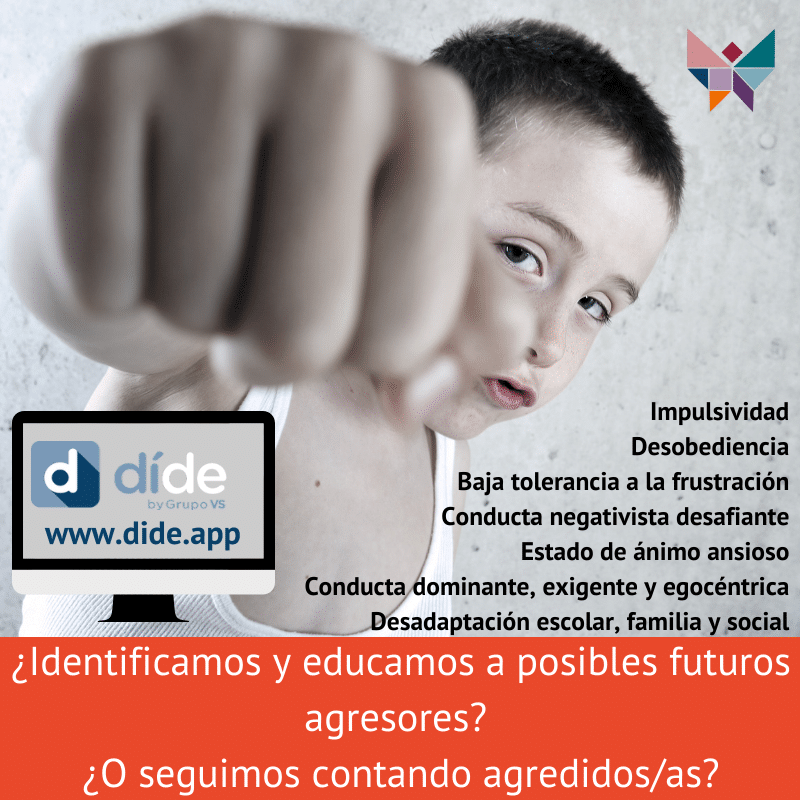
Searching for the “Hostile Behavior Pattern” to help them control and manage their behavior from childhood
What if we could, through prevention, reduce the incidence of bullying, child-to-parent aggression, aggression towards teachers, gender violence, sexual assault, and child abuse?
As is well known, once it is known which children are predisposed to develop these behaviors and there is knowledge of what is happening to the minor, the intervention that is required can be done for the greater well-being of the same.
The díde methodology, created by specialists in education, psychology, and new technologies, is extremely simple, without the intervention of the minor, and through digital questionnaires answered by parents and teachers, the school, psychopedagogical cabinet, and also the family can collect the necessary information to obtain the student’s profile and know what their needs and difficulties are.
With díde we can look for a pattern in an entire course to detect early children who may present this profile. To do this, we select from the 35 indicators studied by díde, those that will provide us with the information we need, which would be the following:
- Dominant, demanding and egocentric behavior
- Disobedience
- Difficulty in managing anger
- School maladjustment
- Family maladjustment
- Low tolerance to frustration
- Oppositional defiant behavior
- Anxious mood
- Social maladjustment
These are behaviors that, if not learned to manage, can lead them to attack other children and even adults. It is necessary that family and teachers know how to manage these profiles from an early age (from 4 years old).
From these selected indicators, a questionnaire is configured that the system will automatically send to the parents and teachers of each child registered in díde.
As the participants in the questionnaire send the answers, the administrator of the díde platform (whether it is the guidance department of an educational center, a professional from a psychopedagogical or speech therapy cabinet, or a family member through the dide familia version), will obtain the information organized to take the appropriate measures.
There are programs, such as RECURRA-GINSO, which arise to provide support and response to families in conflict with their adolescent children.
Communication between the family and the school, key to preventing hostile behavior
An important aspect for the prevention of hostile behaviors is communication between the family and the school, with the díde system, contact is easily and discreetly established between the two areas and, if necessary, also the health area. díde also simplifies the monitoring and evolution of minors.
As specialists from different fields well know, innovations in prevention and, which also work as is the case of early detection with díde, may generate fear since after knowing, action is requested, but the human cost both personally and socially of not doing so is devastating and immense, which far exceeds the figures of preventing.
How to use díde in my educational center?
